|
|
Thursday, November 11, 2004
|
|
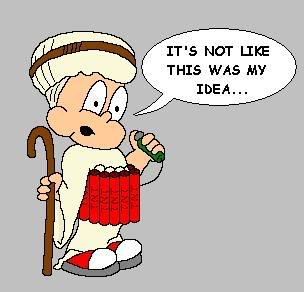
"YASSER, NO SIR/DON'T COME CLOSE/ TO MY HOME, SWEET HOME"
As I'm sure you're all aware by now, Palestinian Authority President Yasser Arafat finally had the good grace to die late last night. In a clear demonstration that only the good die young, President Arafat was 75 years old. The cause of the late Chairman's death, while officially unannounced, sounds suspiciously like AIDS. However, I seriously doubt that this will be revealed until well after he is planted firmly in the ground. Arab reaction to homosexuality is such that it makes John Ashcroft look like a charter member of NAMBLA. Even if Arafat wasn't a screaming queen, most Arabs believe the only way to get HIV is through some good old fashioned "New Jersey lovin'."
The passing of Arafat does raise some important questions, chief among them, will Ringo Starr ever be seen in public again?
Oh, and then there's that whole "peace in the Middle East" thing.
The United States, the United Kingdom and Israel have all taken the position that a final status peace agreement - and therefore the establishment of a Palestinian state - had become impossible with President Arafat at the helm. Now that he is comfortably in Hell, there are some serious questions that need to be asked and answered and there is not much time to do so.
If there is one thing about the career of Arafat that is beyond dispute, it is that he was in control, first of the PLO, then of the Palestinian Authority. Arab politics are considerably different than the kind that you and I are used to. One doesn't lose the state of Ohio then begin planning an inept comeback with one's demented Martian wife in the Middle East. A political defeat there usually culinates with the vanquished's death. Arafat managed to survive in this atmosphere for over thirty years.
Granted, he did so through an intricate web of bribery and corruption that would shock even the Teamsters, and towards the end, by out-terrorizing the terrorists. These tactics, I think we can all agree, are distateful. However, given the rules of Arab politics, they were necessary. Arafat didn't create the rules, he just played them better than anyone else.
This being the case, one has to ask if there is a successor regime that can long survive in the territories. I believe that, if in fact there is, it will be headed by Abu Mazen, but I'm far from sure that he can survive combined recriminations from Israel and Hamas as he is isolated by the Bush administration. Should Mazen be removed, there are only different levels of bad that follow.
While the establishment of a government acceptable to the Bush and Sharon governments is important, it is not the primary task in the coming weeks. The new Palestinian government must be acceptable to, in descending order, the Palestinian people, the other Arab governments, Hamas and Islamic Jihad and then the US and Israel. Any accord between the PLA and Israel that is unacceptable to the Arab street will be ignored in a best case scenario, or lead to an Iraqi-style insurgency in a worst case. Regardless, any regime without broad Muslim support will be crushed within weeks.
The United States must recognize this. The Isrealis already do. They will tell you, off the record, that they are prepared to deal with some corruption and terrorism, if this comes with a stable, sustainable government in the territories. An American rejection of an imperfect Palestinian government could very well lead to a Hamas political takeover of the territories, which is in nobody's interest. The establishment of an actual terrorist government in the territories will be intractable for the US, Israel and the surrounding nations. The only beneficiary of such a government would be Syria and Iran.
Expecting perfection, a particular trait of American conservatives, will lead only to anarchy. The coming weeks will be messy. Of this there can be little doubt. But if it is not managed properly, it could be disasterous.
The Bush administration is already squandering a huge opportunity in not sending Colin Powell to Arafat's funeral in Cairo. State funerals have always served a useful purpose in gauging the political winds. One should remember that when Vice President Bush represented the United States at the funeral of Soviet Leader Yuri Andrpov, he met with the successor, Mikhail Gorbachev. The briefing that he gave President Reagan upon his return, stating that the US could work with Gorbachev, shaped America's Soviet policy for years to come.
I am not suggesting that either President Bush or Vice President Cheney attend. Given the circumstancesin Iraq, they are to polarizing to be useful. But at a minimum, Secretary Powell -and even better, former Presidents Bush and Clinton - should attend. They then could meet with the various factions in the Palestinan political scene. This could determine the course of policy in the coming weeks and months and, if nothing else, give the US an idea of what to expect. If this sounds whimsical, it should be remembered that President Reagan dispacted former Presidents Carter, Ford and Nixon to Anwar Sadat's funeral in 1982 and gave the US a better picture of Hosni Mubarack.
American neoconservatives must resist the temptation to be more Israeli than Israel. Prime Minister Sharon knows better than to sacrifice the good in the name of the perfect. For the American right to refuse to deal with an imperfect Palestinian government (and there is no possibility of a perfect government there right now), it could set the peace process back in such a way that would make the past four years look more like a prologue of things to come than an epilogue to a dying era.
This also has implications for Iraq, as well. If the United States is seen as undermining a (somewhat) democratic government in the territories, it could well determine how Iraqis conduct their own elections in January. To undermine a new Palestinian government serves only to further the cause of Zarqaui and his ilk in Iraq.
It has been said in neoconservative circles that the road to Jerusalem leads through Baghdad. At this point, the road to Badhdad starts in Rammalah. The Bush administration could reaffirm its commitment to democracy for the Iraqis in its conduct in the Arafat succession, or it could demonstrate that it is not serious at all.
The belated death of Yasser Arafat has opened many opportunities. But with those opportunities come significant risks.
Permalink
|
|
|
| |