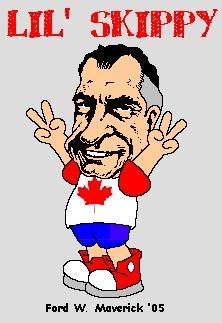
DEEP THROAT, WATERGATE AND THE LEGACY OF RICHARD NIXONPictured to the left is
W. Mark Felt, the Deputy Director of the FBI during the early 1970's.
It was also revealed today that he was Bob Woodward and Carl Bernstien's source known only as "Deep Throat." Deep Throat confirmed much of the information that tied the White House of President Richard M. Nixon to the cover-up of the June 1972 break-in of the Democratic National Committee headquarters at the Watergate office building. That cover-up lead to four articles of impeachment being passed by the House Judiciary Committee and, ultimately, Nixon's resignation of the presidency.
Since the release of Woodward and Bernstein's book
All The President's Men and particularly its film adaptation the identity of Deep Throat has been a cottage industry and spectator sport for people like me. Unlike today's revelation, most of the previous candidates were ridiculous on their face. Among those named were Nixon speechwriters Patrick J. Buchanan, Ray Price and Diane Sawyer. As speechwriters, none had the access to information necessary to be a source. The inclusion of Buchanan's name was the most implausible as he was the strongest of Nixon's defenders until the day the President died, April 22 1994.
Also named at various times were then National Security Adviser Henry A. Kissinger and his deputy (and later White House Chief of Staff) Alexander Haig. Both are insane suggestions. Nixon's relationship with Kissinger was difficult at the best of times and at no time was Kissinger ever involved in domestic policy matters. Later, as Watergate grew, Nixon sought to keep foreign policy separate from the growing scandal and Kissinger was further isolated. In fact, in September of 1973 Nixon named Kissinger Secretary of State so as to preserve Nixon's foreign policy prestige. Haig, as Kissinger's deputy, was in an even worse position to know Watergate related information. When, as Chief of Staff, Haig learned of the "smoking gun tape" that revealed Nixon directing then Chief of Staff H.R Haldeman to have the CIA tell the FBI to back away from the Watergate investigation for "national security reasons", Haig urged Nixon to resign.
Nixon White House Counsel Leonard Garment wrote a book,
In Search of Deep Throat, that named Nixon political operative (and 1980 Reagan campaign manager) John Sears as Deep Throat. Sears was also an implausible candidate as he had been forced out of the White House over a year before the break-in. Others have named acting FBI Director L. Patrick Gray, overlooking that he was convicted of obstruction of justice in Watergate.
Felt is one of the few candidates who makes sense. As Deputy Director of the FBI, he had access to the investigation, the White House and the Committee to Re-Elect the President (CREEP). He was one of the very few people to have had access to all the information necessary to be Woodward and Bernstein's source.
As I began writing this, the
Washington Post revealed on their website that Felt was indeed Deep Throat. Speculation over Felt's motives has begun. As the
Post noted;
Woodward said Felt helped The Post at a time of tense relations between the White House and much of the FBI hierarchy. He said the Watergate break-in came shortly after the death of legendary FBI director J. Edgar Hoover, Felt's mentor, and that Felt and other bureau officials wanted to see an FBI veteran promoted to succeed Hoover.
Felt himself had hopes that he would be the next FBI director, but Nixon instead appointed an administration insider, assistant attorney general L. Patrick Gray, to the post.
Mark Felt also has a long history of denying being Deep Throat. His answers to direct questions about it in the
August 9, 1999 edition of Slate are telling.
Question: Let's just say you were Deep Throat. Would that really be so terrible?
Answer: It would be terrible. This would completely undermine the reputation that you might have as a loyal, logical employee of the FBI. It just wouldn't fit at all.
Question: But a lot of people think Deep Throat is a hero for getting the truth out about Nixon and Watergate.
Answer: That's not my view at all. It would be contrary to my responsibility as a loyal employee of the FBI to leak information.
Could Felt's motives have originated in professional recrimination? That seems to be entirely possible. Mark Felt was a loyalist to J. Edgar Hoover, and the relations between Nixon and Hoover were openly hostile at the time of the latter's death in May of 1972. Hoover had openly blocked several of Nixon's domestic surveillance plans - most notably the 1971 "Houston Plan" - despite his own long history of disregard for civil liberties over the course of 48 years as director.
Hoover's ill-will toward Nixon could very well have carried over to his loyalists. The claim that Felt was "protecting the Constitution" is patently ridiculous. In fact, Felt was convicted of subverting civil liberties in 1980. Felt himself authorized illegal break-ins and wiretaps throughout his FBI career. He was later pardoned by President Reagan.
Felt's trial, and President Nixon's involvement in it, are very interesting. Also from the
Slate article;
A Postscript: On Nov. 1, 1980, Richard Nixon, "after avoiding testifying in twenty other courtrooms over the last six years [writes Robert Sam Anson in Exile: The Unquiet Oblivion of Richard M. Nixon] was on the stand in a criminal case." The defendants were W. Mark Felt and Edward S. Miller, former chief of the FBI's intelligence division, accused of conspiring to violate the civil rights of members of the Weather Underground when they authorized warrantless break-ins of the radicals' homes (the Weatherfolk were suspected of planting bombs in public buildings) in 1972 and 1973.
Nixon thought Felt was Deep Throat. But Nixon was extremely eager to testify on Felt and Miller's behalf, even though he hadn't been subpoenaed. Having successfully and rather strenuously dodged prosecution himself, Nixon had volunteered to walk into a courtroom and testify to help someone he believed had triggered his own downfall. Felt and Miller's lawyers had turned Nixon down because they'd worried that Nixon's reputation would only hurt Felt and Miller with the largely black jury. The prosecution, however, "had been delighted to have him," Anson writes. So Nixon appeared as a prosecution witness. While Nixon took the oath, Black Panthers and former antiwar activists shouted, "Thief!" and "Liar!" called him a "war criminal," and were expelled by federal marshals from the courtroom. (This according to the third volume of Stephen Ambrose's Nixon biography, Nixon: Ruin and Recovery.)
(Editor's Note: For any aspiring Nixon scholars, I highly recommenend both te Anson and Ambrose books as invaluable references for Nixon's post-presidential life. I also highly recommend both of Monica Crowley's books on Nixon in retirement.
On the stand, Nixon said that he thought the warrantless break-ins were perfectly legal. (Although he wasn't asked under oath whether he'd known of or approved them, he'd said earlier that he hadn't.) The president, Nixon said, had power to authorize such break-ins, and so did the FBI, which was an arm of the executive branch. Nixon said there had been "hard evidence" linking the Weather Underground to foreign governments. Nixon said he himself had approved similar break-ins under the 1970 "Houston Plan," which he said was also legal. Nixon gave an impromptu lecture about a president's heavy burden during wartime. "I hope that neither President Carter or Governor Reagan, if he should be president, has to do what I had to do, what Franklin Roosevelt had to do, [here the judge interrupted and told the prosecutor to ask his next question, but Nixon went on] what President Truman had to do, that is, write letters to people whose sons have been killed in war." Possibly in part because of the jury's distaste for Nixon, Felt, and Miller were found guilty and sentenced to pay $5,000 and $3,500, respectively. After Ronald Reagan, who was elected president a few days later, assumed the presidency, he pardoned the two men.
It is almost too irresistible to wonder: Did Nixon serve up his sympathetic testimony because he knew it would alienate the jury and give Deep Throat what he, Nixon, deemed his just deserts? We know that Nixon was a revenge buff who was capable of extraordinarily Machiavellian behaviour. We also know that Nixon sincerely believed that warrantless break-ins of the sort that Felt and Miller (and, under different circumstances, Nixon himself) had authorized were a necessary line of defence against radicals and troublemakers (many of whom did indeed prove to be violent).
Which Nixon testified at Felt's trial--the Nixon wanting to give Deep Throat a little payback or the Nixon who wanted to stand firm against The Punks? Perhaps both.

Perhaps now that the mystery of Deep Throat has ended, Watergate and the legacy of Richard Nixon can be properly evaluated in context. Most of the principals of the era are now dead and the Nixon White House tapes are being released on an almost continual basis. There is enough of a record now to properly evaluate Watergate and the Nixon era.
Watergate - keeping in mind that the phrase came to encompass much more than the break-in and cover-up - was hardly unique. "Watergate" has come to include national security wiretaps, wiretaps on journalists, witness intimidation, obstruction of justice, witness tampering, illegal break-ins and illegal eavesdropping on political opponents. Richard Nixon was not the first or last president to engage in these activities. If anything, President Nixon's actions were the most justifiable.
First, some background.
What came to be known as "Watergate" began with the unauthorized release of Vietnam era review documents known as the "Pentagon Papers." The papers were ordered by President Johnson's Secretary of Defence, Clark Clifford. None of them addressed any Vietnam policy by the Nixon administration. In fact, Nixon was originally prepared to allow them to come out unopposed, knowing that they would damage only the Kennedy and Johnson administrations. However, Henry Kissinger noted that the United States was involved in highly secret negotiations with North Vietnam, the Soviet Union and the People's Republic of China. Kissinger believed that all three would frown upon a national security leak of the proportion of the Pentagon Papers and end the negotiations.
As the Pentagon Papers were published first in the
New York Times and then the
Washington Post , the government filed suit to stop publication of those classified documents. That case,
NEW YORK TIMES CO. v. UNITED STATES (1971) was reversed by the Supreme Court. The Nixon administration then sought to discredit the source of the leak, former DOD analyst Daniel Ellsberg, personally. This involved a team of White House sponsored burglars (or "plumbers" whose mission was to "plug leaks") breaking into the office of Ellsberg's psychiatrist, Daniel Fielding of Los Angeles.
At some point following the Ellsberg break-in, the principal burglars, G. Gordon Liddy and E. Howard Hunt were hired by CREEP. From there, they masterminded and conducted the Watergate break-in.
As Nixon noted in the Felt trial and during his 1977 interview with David Frost, he had no compunction about ordering extra-judicial break-ins. He famously said during the Frost interview, "If the president does it, it isn't illegal." During the same interview, President Nixon said that although he didn't specifically remember authorizing the Ellsberg break-in, he could have, and
would have if he was briefed about it. Nixon cited President Lincoln's suspension of Habeas Corpus rights (at the time reversed by the Supreme Court) as justification.
Viewed alone, Nixon's statement seems extraordinary. However, it should be noted that Hoover brought President Franklin Roosevelt transcripts of surriptiousily recorded conversations for the purpose of satisfying Roosevelt's thirst for gossip. Those break-ins and wiretaps continued through the Truman, Eisenhower, Kennedy and Johnson administrations. The ONLY thing that is unique about what came to be known as Watergate was that those break-ins were conducted by someone other than the FBI on behalf of the Excecutive Branch.

If you were to ask a hundred people randomly to associate a single person with the phrase "illegal wiretaps" , they would respond with Richard Nixon's name. In fact, the one American official who personally authorized the most wiretaps was Attorney General Robert F. Kennedy. Among those taped by Kennedy was a reporter writing a book about Marilyn Monroe and the Reverend Martin Luther King Jr. in what can only be described as "intimate" moments.
The first president known to surreptitiously record his political opponents was Lyndon Johnson, who bugged the campaign plane of not only Nixon, but his own vice-president, Hubert Humphrey. While the Ellsberg break-in can be described as national security related, neither the Kennedy nor Johnson wiretaps can be.
Conversely, there is no evidence to
any standard of proof that President Nixon authorized or, had foreknowledge of, the DNC break-in at the Watergate. It was the most monumentally stupid move ever made. One does not obtain strategic campaign information by breaking into the party's headquarters. That comes from the candidate's headquarters, if at all. From the 3,000 hours of his own tapes, dozens of criminal trials and hundreds of books on the subject, no one has ever conclusively proven that Nixon authorized the break-in or even given a plausible reason why he would.
It cannot be forgotten that when Richard Nixon was in office, the United States was involved in a ground war in Asia and facing the greatest domestic insurrection since the Civil War. In 1970 alone, some 4,000 bombs were detonated in the United States and dozens, if not hundreds of innocent civilians were killed.

In October of that same year, a couple of dozen mailboxes were blown up in Montreal and a British trade delegate and a Quebec cabinet minister were murdered by the Front de Liberation du Quebec (FLQ). Canada responded by imposing martial law.
This is how Canadian Prime Minister Pierre Trudeau
responded to the October Crisis.If a democratic society is to continue to exist, it must be able to root out the cancer of an armed, revolutionary movement that is bent on destroying the very basis of our freedom. For that reason the Government, following an analysis of the facts, including requests of the Government of Quebec and the City of Montreal for urgent action, decided to proclaim the War Measures Act. It did so at 4:00 a.m. this morning, in order to permit the full weight of Government to be brought quickly to bear on all those persons advocating or practicing violence as a means of achieving political ends.
The War Measures Act gives sweeping powers to the Government. It also suspends the operation of the Canadian Bill of Rights. I can assure you that the Government is most reluctant to seek such powers, and did so only when it became crystal clear that the situation could not be controlled unless some extraordinary assistance was made available on an urgent basis.
The authority contained in the Act will permit Governments to deal effectively with the nebulous yet dangerous challenge to society represented by the terrorist organizations. The criminal law as it stands is simply not adequate to deal with systematic terrorism.
The police have therefore been given certain extraordinary powers necessary for the effective detection and elimination of conspiratorial organizations which advocate the use of violence. These organizations, and membership in them, have been declared illegal. The powers include the right to search and arrest without warrant, to detain suspected persons without the necessity of laying specific charges immediately, and to detain persons without bail.
The War Measures Act, which was only repealed in 1985, immediately suspended all civil liberties of all Canadians. Essentially, Prime Minister Trudeau assumed the same powers that President Abraham Lincoln did in the first year of the Civil War.
President Nixon, on the other hand, broke into a psychiatrist's office, tapped his own staff and a few dozen reporters. I'll leave it to my readers which is worse under the given circumstances. Even the worst fantasies of anti-Nixon enthusiasts do not compare with
the War Measures Act.In the scope of recent history, it appears that
what President Nixon did wasn't as bad as the fact that he did it all in such a short period of time and, ultimately, was
caught.Current commentators almost compulsively decry Nixon for "undermining the Constitution." It should however be examined what Richard Nixon did NOT do.
1. He did not pass or sign an Alien and Sedition Act (as President Adams did.)
2. He did not unilaterarily suspend the right to Habeas Corpus (as President Lincoln did.)
3. He did not incarcerate hundreds of thousands of Vietnamese Americans during the war (as President Roosevelt did to Japanese Americans.)
4. He did not attempt to subvert the Supreme Court when it ruled against him by stacking its membership (as President Roosevelt did in 1937.)
5. He did not institute a loyalty oath for federal employees (as President Truman did.)
6. He did not entice the Mafia to join in a plot to assassinate a foreign head of state (as both Presidents Eisenhower and Kennedy did in regards to Fidel Castro.)
7. He did not misrepresent his health to American people for the sole purpose of obtaining or retaining office (as Presidents Cleveland, Roosevelt and Kennedy did.)
8. He did not use a common girlfriend as a go-between to communicate with the head of the Chicago Mafia (as President Kennedy did.)
10. He did not expand social spending as he cut taxes and hid the costs of a growing foreign war (as Presidents Kennedy and Johnson did.)
11. He did not sell weapons to a declared enemy of the United States and divert the profits of those sales illegally to an insurgent movement expressly prohibited by the Congress (as President Reagan did.)
12. He did not commit perjury before a federal judge (as President Clinton did.)
So what did Nixon do? The evidence is incontrovertible that he conspired to obstruct justice and enticed others to commit perjury. His own tapes demonstrate that clearly. These are also the crimes that most reasonable people believe that President Clinton committed. However, as liberals persist in pointing out, Clinton's motives were purely personal. He subverted his oath of office so that he could "lie about sex."

Ironically, it was Bill Clinton, as a 1974 candidate for Congress, who said that that president should be impeached for "lying to the American people."
Richard Nixon's crimes were committed during a time of war, much as Abraham Lincoln's and Franklin Roosevelt's were. Bill Clinton, on the other hand, launched military operations in the
wake of his scandals. He waited a full two months after the East Africa bombings to launch retaliatory strikes in Afghanistan and Sudan. And he did so the day that Monica Lewinsky was called back before the grand jury. What Nixon did was provide the evidence of his own crimes instead of leaving them to history. He was the instrument of his own downfall.
However much his opponents may argue to the contrary, any one of the above noted abuses were FAR worse than Watergate. The only difference is that they were all uncovered in such a short period of time and all came to light while the president was in office. The exceptions to this were Iran/Contra and Lewinsky. By the Watergate standard, both were highly impeachable offences. Morally, Iran/Contra was worse and Lewinsky was exactly what Nixon was forced from office for, obstruction and witness tampering. If "abuse of power" were actually an impeachable offence, every president before and after Nixon, save perhaps Carter and Bush 41, would have been removed from office.
The greatest tragedy of Watergate is that it obscures the good and great accomplishments of Richard Nixon's five and half years in the White House. Nixon was the last truly consequential president of the United States. I firmly believe that history will record Nixon as one of the three or four great presidents of the twentieth century, on par with Theodore Roosevelt, if not Franklin.
In foreign affairs, Nixon is unmatched in achievement. Without the China opening of 1972, the Soviet Union would never have collapsed as quickly as it did. Indeed, there had been a Sino/Soviet schism developing for years, but so long as one communist power believed that the other was aligned with the United States, they both had to be prepared to fight a two-front nuclear war. Before Nixon, it was the United States in such a strategic position.
Nixon was the first president to visit Moscow and the first to enter into an arms limitation treaty with the Soviets. The
Detente era made possible the age of
Perestroika, without which the liberation of Eastern Europe might have been far bloodier than it turned out to be. One could argue that without the strategic posture of the Nixon administration, the rise of Mikhail Gorbachev would not have been possible at all.
Before Richard Nixon's presidency, there were two nuclear powers aligned against the United States. After he left office, those powers were far more concerned with each other than they were America.
Despite
BROWN v. BOARD OF EDUCATION (1954), the overwhelming majority of America's schools were segregated when Richard Nixon became president. After his resignation, a very small percentage were still segregated by race.
Before Richard Nixon became president, it was still legal for labor unions to deny blacks membership, yet still receive federal government projects. With the Philadelphia Plan - the nucleus of what is today known as "affirmative action" - that changed forever.
Before Richard Nixon was president, there was no central federal authority for environmental protection. President Nixon created and fully funded the Environmental Protection Agency.
Before Richard Nixon was president, one-quarter of the Earth's population - armed with nuclear weapons - was as isolated and hostile as North Korea is today. Today, the People's Republic of China is instrumental in restraining North Korea.
As much as the left would like to believe otherwise, and as much as they like to paint him with swastikas now - Richard Nixon may have been the last
liberal president. His rhetoric aside, Richard Nixon may have been the last friend the liberal movement had in the Oval Office. As much as Democrats mouthed the sentiments, it was Richard Nixon who did the deeds.
Can any liberal deny what Richard Nixon did to further their cause? I don't think so.
As much as any conserative would like to paint Richard Nixon as a corrupt abberation of Republican history, he laid the foundation of modern Republican foreign policy.
Can any conservative deny Richard Nixon's place in ending the Cold War? I don't think so.
Republicans would do well to remember that Richard Nixon was the first candidate of his party to win widespread acceptance in the South. Largely he did this by accepting the reality of the New Deal and the Great Society. In addition, he did this while attaining the greatest civil rights record of any president, before or since. Without Richard Nixon, it's an open question as to whether there would be a national Republican Party at all today.
I'm not naive enough to think that Watergate will ever be forgotten. I doubt that it will even be placed in its proper perspective in my lifetime. But I do hope that Mark Feld’s coming out party today will start that process. Perhaps then Richard Nixon will be seen for what he was, both good and bad.
Oh, yes, he knew great controversy amid defeat as well as victory. He made mistakes, and they, like his accomplishments, are a part of his life and record. But the enduring lesson of Richard Nixon is that he never gave up being part of the action and passion of his times. He said many times that unless a person has a goal, a new mountain to climb, his spirit will die. Well, based on our last phone conversation and the letter he wrote me just a month ago, I can say that his spirit was very much alive to the very end.
That is a great tribute to him, to his wonderful wife, Pat, to his children and to his grandchildren, whose love he so depended on and whose love he returned in full measure. Today is a day for his family, his friends, and his nation to remember President Nixon's life in totality. To them, let us say: may the day of judging President Nixon on anything less than his entire life and career come to a close (emphasis added).