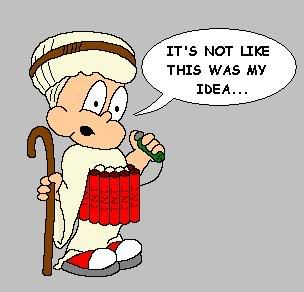
THE BUSH DOCTRINE IN THEORY AND PRACTICE: INCOMPETENCE, HYPOCRISY AND GAZA
Almost from the second he was sworn in as president, George W. Bush began building a foreign policy on a foundation of falsehoods, fantasy and delirium tremens. During the 2004 Democratic primaries, Dick Gephardt described the incumbent president as a "miserable failure," which was something of an understatement. The message however was lost in the fact that Dick Gephardt has no eyebrows.
Despite campaigning on the premise that nation building was something that the United States was best kept far away from, Bush soon decided that he couldn't be a truly failed president until he embraced democracy without ever considering it's implications. This is seemingly key. For that reason, the Iraqi people were relentlessly bombed into the freedom to persue their deepest desire, murdering one another.
To be fair, the president couldn't possibly have known the consequences of the sudden liberation of repressed and atagonistic ethnic groups. It's not like there was any precedent for that. If only there was an experience to draw upon, like in the Balkans, say, ten years before ...
Anyhow, getting people of different ethnic and religious backgrounds to annhiliate one another with car bombs gets tired after a while. That's when you graduate to getting competing terrorist groups to kill one another.
It's kind of a complicated process, so you'll need to bear with me.
First, you get a bunch of terrorists together, give them two slivers of shithole land and let them think it might actually be a country. It's also important that said assholes of land sandwich a country that everybody wants destroyed. Then you force an election that all but the craziest motherfuckers in the region don't want. Then you just add water and stir.
From the enshrinment of the Oslo accords through 2006, the Palestinian Authority was ruled by the Fatah faction of what was formerly known as the Palestinian Liberation Organization. Fatah, and the PLO before it, was little more than a personality cult built around its leader, Yasser Arafat, and defined by his almost physically overwhelming corruption. From time to time, Arafat would allow one of his factions, the al-Aqsa Martyrs' Brigades, to launch terrorist assaults into Isreal as a means of keeping his kleptocracy undisturbed. When Arafat finally had the common decency to die in November of 2004, things got complicated fast.
However, and this is important to remember, the government of Israel continued to deal with Fatah at some level if only because the alternatives were so much worse than Arafat was. Even when the Israeli Defense Force was launching offensives into Gaza and blockading Arafat in his own headquarters, they still recognized Fatah as the legitimate government of the Palestinian Authority.
The Bush administration went much further than did even Israel. They refused to meet with Arafat at all. President Bush and then-National Security Advisor Condolezza Rice, neither of whom even pretended to know very much about the Middle East, positioned themselves to the right of Prime Minister Ariel Sharon vis-a-vis the Palestinans.
Upon Arafat's death, the Fatah leadership was assumed by Mahmoud Abbas. Within a year, Ariel Sharon slipped into an irreversible coma and was succeeded by Ehud Olmert. Unfortunately, Bush and Rice stayed exactly where they were and and made destroying the region something of a hobby.
As we have seen in both Afghanistan and Iraq, President Bush has something of a democracy fetish. The problem is - as scholars of German history have noted - that when you inject democracy into chaos, Adolf Hitler tends to wind up in power. And the Middle East has a long and storied history of chaos.
Bush continued his nonsensical chorus for elections in the Palestinan Authority that began in January of 2001. What followed demonstrates that President Bush not only doesn't understand the Middle East, it also shows that he doesn't understand electoral politics very well.
Fatah was a cauldron of corruption that supported limited terrorism, yet was publicly defined by a personality cult. When the personality heading the cult left the scene, all that was left was the corruption and the conflicting measures in dealing with Israel.
On the other hand, there was never any doubt what Hamas stood for; unlimited terrorism and the ultimate destruction of the Jewish state. But Hamas was also socially active in ways that Fatah never was. They built schools and maintained sewer services, y'know, the kind of shit that you cast ballots for. Much of the infastructure that should have been built and maintained by Fatah was instead the creation of Hamas.
Whether the Palestinian people support terrorism is debatable and electorally insignificant. Hamas made the trains run on time and put the kids in school, which is something that Arafat and Abbas never could. Anyone who knows anything about politics could have told the president of the United States who would win an election between the two.
In fact, both Fatah and the Israelis told the administration what would come of an election in the PA. They knew that Hamas would not only win, but win in a landslide that would destroy the peace process, perhaps forever.
The upcoming issue of Vanity Fair tells the story of what happened next in almost excruciating detail. After reading it, the only people left defending the competence of the Bush foreign policy will be drunkards, the addled, the insane and the most evil people among us.
Dahlan says he warned his friends in the Bush administration that Fatah still wasn't ready for elections in January. Decades of self-preservationist rule by Arafat had turned the party into a symbol of corruption and inefficiency - a perception Hamas found it easy to exploit. Splits within Fatah weakened its position further: in many places, a single Hamas candidate ran against several from Fatah.
"Everyone was against the elections," Dahlan says. Everyone except Bush. "Bush decided, 'I need an election. I want elections in the Palestinian Authority.' Everyone is following him in the American administration, and everyone is nagging Abbas, telling him, 'The president wants elections.' Fine. For what purpose?"
The elections went forward as scheduled. On January 25, Hamas won 56 percent of the seats in the Legislative Council.
Few inside the U.S. administration had predicted the result, and there was no contingency plan to deal with it. "I've asked why nobody saw it coming," Condoleezza Rice told reporters. "I don't know anyone who wasn’t caught off guard by Hamas’s strong showing."
This begs the very important question of just who the Secretary of State is hanging out with?
For a time, the United States believed that Hamas could be brought into the "roadmap" process defined by the U.S, U.N, Russia and the European Union. That illustrates an almost stunning ignorance of not just foreign policy, but basic electoral politics. Expecting Hamas to abandon antogonism to Israel is like expecting the Republican Party to abandon poorly thought out tax cuts and bending over for people like Pat Robertson, which is to say it that isn't something that would happen after a smashing success at the polls. Imagine Lincoln recinding the Emancipation Proclomation in March of 1865 and you sort of get an idea of how well it would work.
What Bush and Rice did in the aftermath of the Palestinian elections not only undermined their own silly "freedom agenda," it set back the credibility of the United States in the region for decades.
Essentially, the administration sought to reverse the results of a free and fair election that nobody wanted but them. And they did so by actually giving military aid to the losers of the election. As you might imagine, overturning the popular will of the Palestinian people tends to undermine your committment to freedom somewhat. That's particularly true if that popular will would never have been expressed in the first place but for your insistence.
The problem was that the newly Democratic Congress refused to authorize lethal military aid for Fatah for fear that it would end up in the hands of Hamas and be used to threaten Israel. But, as Karl Rove teaches us, the Democrats are almost always with the terrorists, so they could be safely ignored.
Of course, the go-to guy in the subsequent scheme was Elliott Abrams. Observers of recent American history might remember Mr. Abrams as a guy who pled guilty to his role in the Iran - Contra affair and was pardoned by the current president's father. That he served the current administration on the National Security Council, which doesn't require Senate confirmation, demonstrates that even the craveness of the Republican Congress of the day had its limits.
What essentially happened afterward is that the United States solicited military aid and training for Fatah's security services from third-party Arab governments, which is sort of what should have gotten President Reagan impeached.
The scheme bore some resemblance to the Iran-contra scandal, in which members of Ronald Reagan’s administration sold arms to Iran, an enemy of the U.S. The money was used to fund the contra rebels in Nicaragua, in violation of a congressional ban. Some of the money for the contras, like that for Fatah, was furnished by Arab allies as a result of U.S. lobbying.
But there are also important differences - starting with the fact that Congress never passed a measure expressly prohibiting the supply of aid to Fatah and Dahlan. "It was close to the margins," says a former intelligence official with experience in covert programs. "But it probably wasn’t illegal."
There are other similarities to Iran-Contra in this scheme. The original Reagan scheme was run out of the National Security Council in the White House basement. The NSC had absolutely no experience in running covert operations on its own and it was a miracle that Iran-Contra survived for the two years that it did. The more recent Bush plan was directed by the State Department, which has even less operational experience in covert action and a widely known reputation for leaks.
And leaks are exactly what happened. The operation, and the American fingerprints on it, leaked to the Arab media and gave Hamas plenty of time to prepare for and crush it. The secret coup against Hamas by Fatah and the United States was no longer secret. Yet, the plans and arms transfers continued. A covert operation that was no longer covert continued as if it was.
The results were disasterous. Not only did Hamas launch a preemptive strike that not only defeated Fatah, they slaughtered its loyalists in the streets. It was a horrific thing to watch, especially if you happened to be an Israeli within striking distance of Hamas' new terrorist stronghold. The arms that the United States skirted the law to transfer to Fatah now belong to Hamas and directly threaten Israel.
The operation was so badly bungled that the Fatah-loyalist al-Aqsa Martyrs' Brigades refused to participate in the defence of Gaza.
Others who stayed out of the fight were extremists. "Fatah is a large movement, with many schools inside it," says Khalid Jaberi, a commander with Fatah's al-Aqsa Martyrs' Brigades, which continue to fire rockets into Israel from Gaza. "Dahlan's school is funded by the Americans and believes in negotiations with Israel as a strategic choice. Dahlan tried to control everything in Fatah, but there are cadres who could do a much better job. Dahlan treated us dictatorially. There was no overall Fatah decision to confront Hamas, and that's why our guns in al-Aqsa are the cleanest. They are not corrupted by the blood of our people.”
Jaberi pauses. He spent the night before our interview awake and in hiding, fearful of Israeli air strikes. "You know," he says, "since the takeover, we've been trying to enter the brains of Bush and Rice, to figure out their mentality. We can only conclude that having Hamas in control serves their overall strategy, because their policy was so crazy otherwise."
You know that a policy is fatally flawed in it's concepetion and execution when even your enemies think that a disaster is what you specifically intended.
As a result of the incredibly awkward stumbling of President Bush and Secretary Rice, not only is Gaza gone, so is the somewhat moderate Fatah. If President Abbas has any hope whatsoever of maintaing power, he is going to distance himself from the United States and Israel in a demonstrable way, thus making an acheivable peace agreement even more difficult than it was before.
Ironically, during the 2000 campaign, President Clinton's Camp David summit was one of the things that George W. Bush railed against the most. His entirely Palestinian policy during the first term comprised of not being a tool of Yasser Arafat. That policy turned Gaza into a dagger pointed at Israel's heart. And it certainly doesn't help Egypt, which trained and participated in arming the Fatah security forces either.
And it isn't like the Bush administration wasn't warned. There were true American patriots like Brent Scowcroft who sounded the warning bells all along.
The status quo, Scowcroft said, is not necessarily a good thing, but it might be better than what follows. "My kind of realism would look at what are the most likely consequences of pushing out a government. What will replace it?" What will replace autocratic but stable governments, neoconservative thinkers say, is whatever the people of the Middle East decide will replace them. Robert Kagan, of the Carnegie Endowment for International Peace, and a Kristol ally, has written critically of the Bush Administration’s incomplete adherence to its own anti-tyranny doctrine. Referring to President Hosni Mubarak of Egypt, Kagan wrote, "Perhaps there is concern that too much pressure on Mubarak might produce a victory by the Muslim Brotherhood, the most popular Egyptian opposition party, which has been outlawed by the government. That's a risk, of course, but if the Bush Administration isn't willing to let Islamists, even radical Islamists, win votes in a fair election, then Bush officials should stop talking so much about democracy and go back to supporting the old dictatorships."
Scowcroft believes that the Administration has already gone too far in Kagan's direction. "Let's suppose Mubarak disappears and we have an election," he said. "The good guys are not going to win that election. The bad guys are going to win that election. The bad guys are always better organized. Always. The most ruthless, the tough ones, are the ones who are going to rise to the top in a chaotic society. That’s my fear."
The Bush Administration does not, as a rule, concede that democratization in the Middle East could lead to a series of Islamist states. One day, I mentioned to Scowcroft an interview I had had with Paul Wolfowitz, when he was Donald Rumsfeld’s deputy. Wolfowitz was the leading neoconservative thinker in the senior ranks of the current Bush Administration. (He is now the president of the World Bank.) I asked him what he would think if previously autocratic Arab countries held free elections and then proceeded to vote Islamists into power. Wolfowitz answered, “Look, fifty per cent of the Arab world are women. Most of those women do not want to live in a theocratic state. The other fifty per cent are men. I know a lot of them. I don’t think they want to live in a theocratic state."
Scowcroft said of Wolfowitz, "He's got a utopia out there. We're going to transform the Middle East, and then there won't be war anymore. He can make them democratic. He is a tough-minded idealist, but where he is truly an idealist is that he brushes away questions, says, 'It won't happen,' whereas I would say, 'It's likely to happen and therefore you can't take the chance.’ Paul's idealism sweeps away doubts." Wolfowitz, for his part, said to me, "It's absurdly unrealistic, demonstrably unrealistic, to ignore how strong the desire for freedom is."
Maybe not so much.
How can you call Afghanistan a democracy when the elected government only controls approximately 30% of its terroritory? How can you say that the surge in Iraq is a success when you don't know what will happen when the surge draws down? How can any rational person look at the Palestinian Authority or Lebanon and say that democracy is working? How can any right thinking human being look at what George W. Bush has done to the world and not say "What in the fuck has happened to American foreign policy?"
How can anyone call themselves a conservative and support anything that this president has done? President Bush has not only reversed the trends of the end of the Cold War, he's rapidly sending the world back into the Dark Ages.
Don't think that the next president is going to fix this, either. Barack Obama and Hillary Clinton are promising to further antagonize the rest of the world by reopening settled trade and defence agreements and John McCain is going to be a captive of his own idiot right.
Unfortunately, reasonable people like Richard Nixon and Gerald Ford are dead and Henry Kissinger, James Baker, Brent Scowcroft and the first President Bush are too old to do the decades of work that it will take to undo the disaster this administration has wrought.
A few years ago, I compared George W. Bush unfavorably to Lyndon Johnson. In retrospect, I was far too charitable in my evaluation of the current president. President Johnson only destroyed Vietnam and did a decade's worth of damage to the American economy. Even that was mitigated by his heroic stands in civil rights and the establishment of Medicare. Everything President George Walker Bush has gotten close to has been ruined almost beyond repair. The man is either incompetent, malevolent, cursed or all three.
Anyone who has ever wondered what Mr. Magoo would be like as president can put down their hashpipes.
Comparing Bush to other American presidents is a fool's game. By almost any standard, the guy falls short of even a shitheel like Fidel Castro in the leadership sweepstakes. Both have detained people under questionable circumstances in Cuba, but Castro was at least able to raise his nation's literacy rate. Cuban hospitals might be cesspools, but so is Walter Reed.
I love the United States and the American people with all of my heart, but I despair over what it's become over the last twenty years. As voters become increasingly disengaged with the electoral process, idealogical "base turnout" has become the most effective way to win. That means what P.J O'Rourke once lovingly described as "Bullshit, Money and Television" carries the day. And that's how people like Bill Clinton and George W. Bush come to power. I've spent way too many years and too much money studying the American presidency to see it become a tool by which one can get more blowjobs and wage epic Oedipal battles. The last sixteen years should demonstrate better than anything else what "process politics" brings.
I'm not going to stand here and tell you that my country is any better politically. In a lot of ways, Canada is far worse. We build up leaders only to destroy them forever and we're much better at it than Americans are.
But we don't tout ourselves as the "leader of the free world." We don't have a nuclear arsenal, a giant army or a tendency to fuck about in the politics of other nations. All of those things carry with them a special responsibility.
I know that Americans get awfully pissy when foreigners like me point out the flaws in your electoral process, but the decisions you make when you aren't eating pork rinds and beating your wives during Super Bowl commercials are felt around the world. Like it or not, that gives the rest of us the right to an opinion. I don't remember all of you Republican assholes getting all that uppity when a ton of Iraqis were waving purple fingers and sitting next to Laura Bush at the State of the Union address. You don't get to play policeman of the world unless we can see your badge.
Besides which, when American foreign policy irredeemably fucks up a place like, say, Central America or Somolia, Canadian peacekeepers get to go in and try to fix it without things like money and guns.
Any halfway smart person will read the next issue of Vanity Fair and ask what's worse; a country that deliberately arms and empowers terrorists, or one that does so by accident.
State of War: The Secret History of the CIA and the Bush Administration by James Risen Finished, Thursday 19 January 2006
A Simple Twist of Fate: Bob Dylan and the Making of Blood on the Tracks by Andy Gill and Kevin Odegard Finished, 23 January 2006
Grits: An Intimate Portrait of the Liberal Party By Christina McCall-Newman Finished, 17 March 2006
Running the World: The Inside Story of the National Security Council and the Architechts of American Power by David Rothkopf Finished, 6 April 2006
Strategery: How George W. Bush is Defeating Terrorists, Outwitting Democrats and Confounding the Mainstream Media By Bill Sammon Finished, May 10, 2006
George Wallace: American Populist By Stephan Lesher Finished, June 15, 2006
Secrets of the Kingdom: The Inside Story of the Saudi - U.S Connection By Gerald Posner Finished, June 20, 2006
Soldiers of God: With Islamic Warriors in Afghanistan and Pakistan By Robert D. Kaplan Finished, June 27, 2006
Before the Storm: Barry Goldwater and the Unmaking of the American Consensus By Rick Perlstien Finished, July 4, 2006
Flawed Giant: Lyndon Johnson And His Times 1961-1973 By Robert Dallek Finished, August 10, 2006
Bush's Brain: How Karl Rove Made George W. Bush Presidential By James Moore and Wayne Slater Finished, October 7, 2006
The Fall Of Baghdad By Jon Lee Anderson Finished, October 31, 2006
The Way It Works: Inside Ottawa By Eddie Goldenberg Finished, November 12, 2006
Child Of God By Cormac McCarthy Finished, November 18, 2006
Right Side Up: The Fall Of Paul Martin And The Rise Of Stephen Harper's New Conservatism By Paul Wells Finished, December 8, 2006
The Private Life Of Chairman Mao By Dr. Li Zhisui, Translation By Tai Hung Chao Finished, December 14, 2006
Exile On Main Street: A Season In Hell With The Rolling Stones By: Robert Greenfeild Finished, February 21, 2007
"Work Hard, Study ... And Keep Out Of Politics!" Adventures And Lessons From An Unexpected Public Life By: James A. Baker, III with Steve Fiffer Finished, March 7, 2007
Supreme Conflict: The Inside Story Of The Struggle For Control Of The United States Supreme Court By Jan Crawford Greenburg Finished, March 14, 2007
Imperial Life In The Emerald City: Life Inside Iraq's Green Zone By: Rajiv Chandransekaran Finished March 18, 2007
Memories Of My Melancholy Whores By: Gabriel Garcia Marquez Finished, March 21, 2007
Guests Of The Ayatollah: The First Battle In America's War With Militant Islam By: Mark Bowden Finished, April 4, 2007
Screwjack By: Hunter S. Thompson Finished, April 19, 2007
State Of Denial: Bush At War, Part III By: Bob Woodward Finished, April 22, 2007
31 Days: Gerald Ford, The Nixon Pardon, And A Government In Crisis By: Barry Werth Finished, May 6, 2007
At The Center Of The Storm: My Years At The CIA By: George Tenent with Bill Harlow Finished, May 28, 2007
No Excuses: Concessions of a Serial Campaigner By: Robert Shrum Finished: July 1, 2007
Chief of Staff: Lyndon Johnson and His Presidency By: W. Marvin Watson with Sherwin Markmarn Finished: July 12, 2007
Nixon and Kissinger: Partners in Power By: Robert Dalleck Finished: July 17, 2007
1912: Wilson, Roosevelt, Taft & Debs - The Election That Changed The Country By: James Chace Finished: August 5, 2007
Becoming Justice Blackmun: Harry Blackmun's Supreme Court Journey By: Linda Greenhouse Finished: August 20, 2007
President Reagan: The Triumph of Imagination By: Richard Reeves Finished: September 20, 2007
Dead Certain: The Presidency of George W. Bush By: Robert Draper Finished: October 1, 2007
Harper's Team: Behind the Scenes in the Conservative Rise to Power By: Tom Flanagan Finished: October 9, 2007
Full Circle: Death and Resurrection in Canadian Conservative Politics By: Bob Plamondon Finished: October 17, 2007
My Years As Prime Minister By: Jean Chretien Finished: October 23, 2007
The Thumpin': How Rahm Emanuel and the Democrats Learned to Be Ruthless and Ended the Republican Revolution By: Naftali Bendavid Finished: October 25, 2007
Not A Suicide Pact: The Constitution in a Time of National Emergency By: Richard A. Posner Finished, October 29, 2007
Slash By: Slash and Anthony Bozza Finished: November 1, 2007
The Heroin Diaries: A Year in the Life of a Shattered Rock Star By: Nikki Sixx and Ian Gittin Finished: November 2, 2007
Clapton: The Autobiography By: Eric Clapton Finished: November 5, 2007
Rise of the Vulcans: The History of Bush's War Cabinet By: James Mann Finished: November 13, 2007
Miami and the Siege of Chicago: An Informal History of the American Political Conventions of 1968 By: Norman Mailer Finished: November 15, 2007
Memoirs: 1939-1993 By: Brian Mulroney Finished: December 3,2007
Peace Kills: America's Fun New Imperalism By: P.J O'Rourke Finished: December 4, 2007
The Looming Tower: Al-Qaeda and the Road to 9/11 By: Lawrence Wright Finished: December 11, 2007
The One Percent Doctrine: Deep Inside America's Pursuit of Its Enemies Since 9/11 By: Ron Suskind Finished: December 19, 2007
Cheney: The Untold Story of America's Most Powerful and Controversial Vice President By: Stephen F. Hayes Finished: December 25, 2007
When Trumpets Call: Theodore Roosevelt After the White House By: Patricia O'Toole Finished: January 1, 2008
America's First Dynasty: The Adamses, 1735-1918 By: Richard Brookhiser Finished:January 7, 2008
The Road By: Cormac McCarthy Finished: January 9, 2008
The Conviction of Richard Nixon: The Untold Story of the Frost/Nixon Interviews By: James Reston, Jr. Finished" January 11, 2008
Write It When I'm Gone: Remarkable Off-the-Record Conversations with Gerald R. Ford By: Thomas M. DeFrank Finished: January 15, 2008
The Bush Tragedy By: Jacob Weisberg Finished: January 18, 2008
When All You Have Is Hope By: Frank O'Dea with John Lawrence Reynolds Finished: January 21, 2008
Confessions of a Political Hitman: My Secret Life of Scandal, Corruption, Hypocrisy and Dirty Tricks That Decide Who Gets Elected (and Who Doesn't) By: Stephen Marks Finished: February 8, 2008
The Nine: Inside the Secret World of the Supreme Court By: Jeffery Toobin Finished, February 18, 2008
The Architect: Karl Rove and the Dream of Absolute Power By: James Moore and Wayne Slater Finished, February 21, 2008
Team of Rivals: The Political Genius of Abraham Lincoln By: Doris Kerns Goodwin Finished, February 26, 2008
Post Office By: Charles Bukowski Finished: March 6, 2008
Factotum By: Charles Bukowski Finished: March 7, 2008
Women By: Charles Bukowski Finished: March 10, 2008
Queer By: William S. Burroughs Finished: March 12, 2008
To Live's To Fly: The Ballad of the Late, Great Townes Van Zant By: John Kruth Finished: March 17, 2008
Twenty Thousand Roads: The Ballad of Gram Parsons and His Cosmic American Music By: David N. Meyer Finished: March 24, 2008
W.A.R: The Unauthorized Biography of William Axl Rose By: Mick Wall Finished: April 4, 2008
Deception: Pakistan, the United States, and the Secret Trade in Nuclear Weapons By: Adrian Levy & Catherine Scott-Clark Finished: April 21, 2008
The Assassins' Gate: America in Iraq By: George Packer Finished: May 5, 2008
Worse than Watergate: The Secret Presidency of George W. Bush By: John W. Dean Finished: May 7, 2008
Clinton in Exile: A President Out of the White House By: Carol Felenthal Finished: May 12, 2008
Nixonland: The Rise of a President and the Fracturing of America By: Rick Perlstein Finished: June 2, 2008
Infidel By: Ayaan Hirsi Ali Finished: June 11, 2008
The People's Machine: Arnold Schwarzenegger and the Rise of Blockbuster Democracy By: Joe Mathews Finished: June 20, 2008
The Strong Man: John Mitchell and the Secrets of Watergate By: James Rosen Finished: June 30, 2008
American Spy: My Secret History in the CIA, Watergate & Beyond By: E. Howard Hunt w/ Greg Aunuapu Finished: July 4, 2008
Legacy of Ashes: The History of the CIA By: Tim Weiner Finished: July 16, 2008
The Prosecution of George W. Bush for Murder By: Vincent Bugliosi Finished: July 21, 2008
War by Other Means: An Insider's Account of the War on Terror By: John Yoo Finished: July 25, 2008
Your Government Failed You: Breaking the Cycle of National Security Disasters By: Richard A. Clarke Finished: July 31, 2008
The Persian Puzzle: The Conflict Between Iran and America By: Kenneth M. Pollack Finished: August 13, 2008
The Human Factor: Inside the CIA's Dysfunctional Intelligence Culture By: Ishmael Jones Finished: August 19, 2008
Havana Nocturne: How the Mob Owned Cuba ... And Then Lost It to the Revolution By: T.J Enjlish Finished: August 25, 2008
Descent into Chaos: The United States and the Failure of Nation Building in Pakistan, Afghanistan and Central Asia By: Ahmed Rashid Finished: Sepember 9, 2008
The Case Against the General: Manuel Noriega and the Politics of American Justice By: Steve Albert Finished: September 25, 2008
Condolezza Rice: An American Life By: Elisabeth Bumiller Finished: October 10, 2008
Presidential Courage: Brave Leaders and How They Changed America, 1789-1989 Michael Beschloss Finished: October 13, 2008
What People Are Saying About skippy
"hands down, Canada's most underrated blog" Damian Penny, The Undisputed Dean of Canadian Political Bloggers. Posted at Daimnation , Saturday October 21, 2006
"You can count on “Skippy” to make you think in different ways about familiar issues. You can also depend on him to be rude, offensive, and outrageous – if you're offended by completely uninhibited sexual imagery (and imagination!), don't read Skippy – but your prudery will keep you from an often interesting perspective." Posted On: Jamulblog, July 12, 2007
"Your Maximum Leader is beginning to think that the less he posts, the better Skippy’s political posts are. Indeed, your Maximum Leader even thought (just a few short moments ago) that if your Maximum Leader just stopped blogging all together would Skippy just keep on writing enough good material for two blogs? (Admittedly one of those blogs would be an X-rated social commentary/diary site and the second a remarkably well-informed and insightful political commentary site…)" Posted On: Naked Villainy, September 18, 2007
"I love your writing. few could pull off sarcastic humor and self-loathing like you do. You've turned self-disgust
into an art form." Posted By:Ophelia July 19, 2003
"hahaha um, not funny" Posted By: Ophelia July 17, 2003
"This is not fucking funny." Posted By: Bee August 21, 2003
"I join Bee in saying that this isn''t funny AT ALL. jesus christ, Skippy." Posted By: Ophelia August 23,
2003
"You are obiviously being kept down by the Mud People." Posted By: DrReverend August 21, 2003
"I''ll give you $50.00 if you kill yourself." Posted By: DrReverend August 19, 2003
"Last time I read this blog." Posted By: Dave, October 24, 2003
"I think you should stop talking about killing yourself and ACTUALLY kill yourself. For fuck's sake, everybody is
tired of hearing about how you might, just do it or face the fact that you are too pathetic to even kill yourself."
Posted By: A Caring Guy, October 25, 2003
"If Joey Ramone were alive today he'd probably shit in your mouth." Posted By: DrReverend November 11,
"When you're good, you're good. When you're bad, you're even better. See you in hell." Posted By: Anna
November 11, 2003
"Skippy, if you can prove to me that giving head and swallowing will without a doubt keep lung cancer and heart
disease at bay, you've earned yourself a BJ." Posted By: Mary Magdalicious, December 5, 2003
"Wow...you know nothing about politics." Posted Dr. Reverend, December 26, 2003
"You are a dick and should think seriously about killing your stupid blog - go get a job, you big fag"Posted
By: Princess Paragonian, December 29, 2003
"You have a, how shall i say.... appealing 'tough', yet gently gay look." (Univited PM) Posted
by:Jus20012002, January 2, 2004 .
"I hope jesus doesn't kick you in the nuts."Posted By: Mary Magdalicious February 2, 2004
"Stumbled on to your blog by accident and i must say alot of the stuff had me in stitches. Love it" Posted
By:Jeremy February 4, 2004
" .....sick."Posted By: Bee February 7, 2004
"Hey Skippy, you ever consider running for public office in the states? I know some people in the West Virginia state
government and our Senator can't live forever.Hell, even Strom, Thomas-Jefferson-Fan, Thurmond died
eventually.Posted By: Ford W. Mavrick, February 9, 2004
Wow, for someone who is so opinionated, you really don't know shit about American or Canadian culture. You appear to
know even less about history." Posted By: Dr. Reverend February 13, 2004
"Your blog's the best I have come across in a long time. I may not agree with all you say but the verve with which
you say it and the humour and irreverance is terrific. These days when the media just reproduces the handout from central
control, blogs like yours do a great deal to form informed opinion in a democratic society. Thanks. Keep it up."
Posted By:Anandan February 13, 2004
"SKIPPY pities ME? Where's my noose?" Posted By: Kilgore Trout March 22, 2004
"Jesus Skippy. Now Allah is going to kick you in the nuts" Posted By: Mary Magdalicious March 22, 2004
"I could make one that says "Skippy has a small penis" although his cock is superb. Posted By: Bestest Pussy March 23,2004
"Cunt sucking is for bitches.You're considered one of the girls because you dress like one. Posted By: Dr. Reverend March 24, 2004
"John Malkovich is one sexy bastard. I have such a thing for him. And I never realized til now, Skippy, how much you resemble John Malkovich...this, by default, makes you also one sexy bastard. See how that works?" Posted By: Zombie March, 26, 2004
"Too bad you live up north. It could have been beautiful.
Ever since I started coming here and saw your pic I wondered why you weren't getting more action. You are not a bad looking guy at all.
Maybe the girls are just...well, that's enough kindness for one day." Posted By: Serenity March 26, 2004
"Hell, if they make gay marriage legal, I'll marry you..." Posted By: Outpatient March 26, 2004
"You look creepier than the REM faggot. But he looks much more like a homersexual." Posted By: Dr. Reverend March 27, 2004
"Skippy, your hits will go up again if you post pictures of your man nipples. Lots of man nips." Posted By: Mary Magdalicious April 15, 2004
"What the fuck? You turning faggot? Posted By: Dr. Reverend April 16, 2004
"Sometimes it gets to be just a little too much. Sharing, that is." Posted By: Bee May 23, 2004
"I'll give you $5.00 if you make the fucking font you use on your blog bigger.
I'll give you $50.00 if you stop fucking writing about American politics.
I'll give you $500.00 if you fucking kill youself." Posted By: Dr. Reverend May 26, 2004
"Of course women like jerks.
Why the fuck do you think they like me?
I guess you've learned nothing from me over all these years." Posted By: Dr. Reverend May 29, 2004
"Sometimes a bitch just has to die." Posted By: Ford W. Maverick May 29, 2004
"It looks like we have more in common than the swastikas carved in our foreheads."Posted By: Dr. Reverend May 29, 2004
"This might be a shallow and 'Waiting-for-Godot-like' comment but...you seem to have not only brains but also beauty." Posted By: Nietzscheswife June 7, 2004
"Skippy, you are such a twisted bastard. Seriously. Why haven't we had sex yet?"Posted By: 0phelia June 25, 2004
"Just found your site. I find some of the things you say quite disgusting. And really quite enjoyable,so keep up the good work."Posted By: Big Al June 28, 2004
"I've read most of your blog. I'd say that so far it's the best I've come across, and believe me, I've seen a few. It's funny, well written (except for the spelling...) and interesting. There will always be those few idiots who just don't get it. It's useless to get worked up about it." Posted By: Johnny June 30, 2004
"Skippy... Go for the facial tattoo. I dig em', and fuck what those other bitches think. You can always bite their tits off if they back talk you." Posted By: Mary Magdalicious July 1, 2004
"Go fuck yourself up your butt." Posted By: Reek Stankleberry July 6, 2004
"Well if ass-fucking won't keep Satan away, I just don't know what will." Posted By: Dr. Reverend July 7, 2004
"dude, you're killing me. keep it up." Posted By: Son of Nixon July 22, 2004
"Are you always either naked or in a suit?" Posted By: Rehella July 22, 2004
"That person should speak for himself or herself. 'Cause you really are that much of a cunt, skippy." Posted By: Kilgore Trout August 4, 2004
"I've read you for a long time but have never commented before. That isn't a slight to your great writing ability, it's mainly because I don't want to be seen here!" Posted By: Paul August 4, 2004
" Dead on. Bulls-eye. I take back what I said about you being a cunt. For now." Posted By: Kilgore Trout August 4, 2004
"Know what, Skippy? You're alright." Posted By: Anna August 18, 2004
"Excellent work. Damn you for being so dead on." Posted By: The Maximum Leader August 24, 2004
"Skippy, fuck the puppy idea. Try getting a monkey that smokes. That will get you laid." Posted By: Mary Magdalicious August 27, 2004
"As to the beard - I like the clean shaven better - and what's wrong with a bald head? Bald heads are hot on some guys - unfortunately most can't pull it off * sigh * You look like you can pull it off though and that's a good thing - not a bad.
BTW, love your blog. I saw it in my referrers and thought it was just a random hit. Then I started reading and found you to be hilarious - it was only after about 10 posts that I noticed you linked me. I was more than flattered - linked by someone I was about to link anyway - awesome. Thanks" Posted By: Kinky August 27, 2004
"Fuckin' Goy bastard." Posted By: Dr Reverend December 19,2004
"Who does a guy have to sleep with to get one of his Skippy quotes pasted to the sidebar?
Great googly-moogly." Posted By: Smallholder December 20, 2004
"Are you a child molester or what's the story?" Posted By: Fukinator, December 28, 2004
"Sick dude." Posted By: DCayer December 29, 2004
"You officially suck." Posted By: Sorry, January 22, 2005
"I heart you, Skippy" Posted By: Karinsky, January 25, 2005
"As I've stated before, you were quite skilled in bed and I had no need to fake any of my multiple orgasms." Posted By: 0phelia, June 30, 2005
"I love Skippy. I swear I do. The only blogger more twisted than me." Posted on: Velociworld, July 26, 2005
" You are so fucking ignorant about America. And while the American people ARE stupid, so are you." Posted By: Bill Lassiter, August 2, 2005
"How can you not love a man who hates himself so viciously?" Posted on: It's All About De , August 31, 2005
"If I wasn't positive that all Canadian men had tiny penises, I'd be all over that Skippy." Posted On: It's All About De
"I've seen pictures of you and I'd say you're fuckable." Posted By: Joan, September 29, 2005
" I love your posts on Canadian politics even more than I love your posts on porn.
And I love your porn posts.
Why the hell do you waste all this talent on the internet? Write a book or something, goddammit! Posted By: Cliff S., November 17, 2005
"Let it never be said that underneath your self-cavilling, bitter (yet strangely egomaniacal) surface that you never take the time to give the people what they want. Even if it's just one people. Gawd bless you, Skippy! Posted By: Locke, November 18, 2005
"Wow! I don't know that I've ever been flattered and yet somewhat revolted at the same time... It's an interesting sensation." Posted By: Dewey in Toronto, December 1, 2005
"Very often, debating you is like playing whack a mole: You pop up some premised assertion moles, I pull out my mallet and start whacking, then you pop up more premised assertion moles - which are mostly or completely unrelated to the original moles I was whacking at. Your stock of moles seemingly stretches into infinity. And yet, an endless supply of moles does not equate to cogent argument.
Very often, debating you is like speaking to a salesman who will not answer a particular direct question, and instead flies off on the flight of rhetorical splendor known as "baffling them with bullshit." I'm impressed with your rhetorical skills, and your IQ, and your accumulation of knowledge. I'm impressed that I'm the American citizen, yet you might have a more thorough knowledge of the American Constitution than I. And yet, these impressive things are not substitutes for cogent argument."Posted By; gcotharn, December 21, 2005
"Besides, you seem to think you're the least respectable person I know. While you're often right, you're wrong on that count. Careful, I might out YOU as a nice guy. Or something." Posted By: Dewey In Toronto, December 27, 2005
"I've been to Toronto. The most dangerous thing I saw there was an 11 foot tall red head with shaved balls."Posted By: Judy, December 31, 2005
"There was this "Caught on Tape!" video I watched back in my highschool days where one of the scenes shows two people starting to cross the railroad tracks. One looks up at the last minute and sees the train, the other does not. In the commercial, it cuts away just before the train does its thing, but the video...
Your blog is like a twisted version of the video. We know the train is going liquify you in shocking gory fashion, but that's why we keep coming back. It's so much more fun that we both know the train is coming and you still gleefully walk into its path...and we love you all the more for it." Posted By:Locke, January 13, 2006
"Fuck. I'm hooked." Posted By: DeAnna, January 14, 2006
"Your Maximum Leader has found Skippy's commentary more insightful and interesting than anyone elses. So now he supposes that Skippy will go back to writing about porn and strippers he meets in the subway." Posted By: The Maximum Leader on Naked Villainy January 24, 2006
"Slightly crazed is fine, but with the beard you look like a total nutjob. If you ever hope to get laid again, for fuck's sake, Skippy, NEVER, EVER grow a saddam beard. You're welcome."Posted By: The Lady O, 28 January, 2006
"Maybe we should get married. My readers could support us by purchasing my worn panties and you could be the panty pimp." Posted By; Joan 28 January 2006
" I know it must be hard for you...being objectified by women all the time. But come on, how can they really help themselves? Have you seen yourself lately? Your pheramones preceed you into a room (as does your crotch). Don't blame it all on them...you did choose to leave your house. :D" Posted By: Joan, 3 February, 2006
"Skippy, you sarcastic twerp." Posted By: Arwen, 8 February 2006
"Just so you know.. if I had to choose between Moussaoui or Skippy.. You'd win. Even if I know what an asshole you are. Posted By; Judy, 13 February 2006
"I'd be willing to sign a legal document stating that is IS ok, in fact, to masturbate whilst thinking of me." Posted By: DeAnna (Who seems unaware of my reputation as an outlaw) February 24, 2006
"Feel free to masturbate while thinking of me...actually, do you need some of my panties to help you with that?" Posted By: Joan, February 24, 2006
"I blame myself for this. I have been too lenient with you. Your Godless behaviour must come to an end. You will receive a severe beating this weekend and I am contemplating removing your testicles." Posted By: Dr. Reverend, February 24, 2006
"Just remember skippy, the US never threw a fit when you smuggled your own personal WMD over the border twice a year. After all, it wasn't like you were hiding in your pants or anything.
All's fair in love and war, so to speak." Posted By: Judy, April 4, 2006
"Wow...nothing hotter than a man willing to issue fatwas for pussy." Posted By: Joan, April 16, 2006
"You sir, are a brilliant writer." Posted By: Judy, May 4, 2006
"I think I'm falling in love." Posted By: DeAnna, May 11, 2006
"THIS IS THE MOST DIABOLICAL FALSITY YOU HAVE EVER ENGAGED IN!!!!
I was intending to kick you in the face upon our next meeting, but now it's obvious that I must douse your scrotum in kerosene and set your testicles aflame. Alas, it is the only way you will learn." Posted By: Dr. Reverend, May 12, 2006
"And i would like to commend you on some excellent blogging. This particular story would normally warrant a few cryptically humorous lines and a link. To an ordinary blogger. But you managed to wring an essay of New Yorker-esque proportions out of it. That takes talent. Your beautiful young friend is right. I see big things for you in the future." Posted By: Annika, June 4, 2006
" I like a man who will unabashedly tell someone his penis size because hes unashamed. Thats hot.
*raises hand* I'll take that 6.5, thank ya" Posted By: Kinky, June 6, 2006
"Elvis, like skippy, is the very definition of rock and roll. Posted By: Rube, June 10, 2006
" I'm beginning to think you're the only good man left in the world, skippy. WTF?" Posted By: By: DeAnns, June 11, 2006
"Just so everyone knows.
Skippy does indeed, taste like bacon.
And, any guy who doesn't know cum tastes good to real women, is clueless." Posted By: Judy, July 2, 2006
"There was a British columnist whose work was described as 'a suicide note in weekly installments.'
This blog is sort of like that." Posted By: Gadfly, July 6, 2006
"Jeez, Skippy. Sometimes I really hate coming here." Posted By: Cynlee, July 18, 2006
"Someone needs to throttle you with a riding crop...truly!" Posted By: Joan, July 18, 2006
"Holy mother of god. I just had an orgasm. It's official: I'm devoting the rest of my life to you, skippy." Posted By: DeAnna, July 19, 2006
"Skippy, sometimes I'm not quite sure of your sanity, but you are without a doubt the baddest morning news reading, quiz show hosting, talent introducing PIMP in the motherfuckin' blogosphere." Posted By: Shank, July 19, 2006